Choosing the right field employee tracking software for HR requires more than just presenting its features to prospective buyers. You have to strategically pitch the software, keeping in mind their business challenges and expectations.
System integrators face challenges in balancing the different concerns, expectations, and real outcomes of HR heads and operational managers. Managers demand improved visibility, faster execution, and growth-oriented performance from field teams. Whereas privacy, payroll accuracy, and assurance of legal compliance are the core requirements for HR leaders.
Most pitches fail because they do not create a balance that meets the needs and priorities of both decision-makers. To make sure your pitch impresses both the core decision makers, you need to focus on more than just tracking.
Therefore, HR field employee tracking software must deliver accuracy, transparency, safety, and performance efficiency for field teams. This approach will bridge the gap between the unique requirements of both the decision makers and allow you to lead with clarity and confidence.
Now that you understand the reasons for the challenges you are facing, let us see how to turn HR concerns into approvals with a strategic approach.
1. Why does pitching to the HR leaders require a strategic approach
Pitching a solution to HR leaders requires a different approach than that of the operations managers. Managers look for speed, accuracy, and efficiency in field team activities, while HR leaders focus on safety, security, privacy, and legal compliance.
Therefore, your pitch must align with their priorities on payroll accuracy, employee trust, and compliance with company policies. You must clearly highlight the benefits of the solution, focusing on timely payments, employee safety, and fair performance evaluation.
By solving these key challenges, you become successful in convincing HR leaders to adopt a new software and build trust and credibility with your prospective client.
2. Tips for pitching a field employee tracking software to the HR heads
Before pitching software and explaining its features, start by asking questions to address the real pain points HR faces.
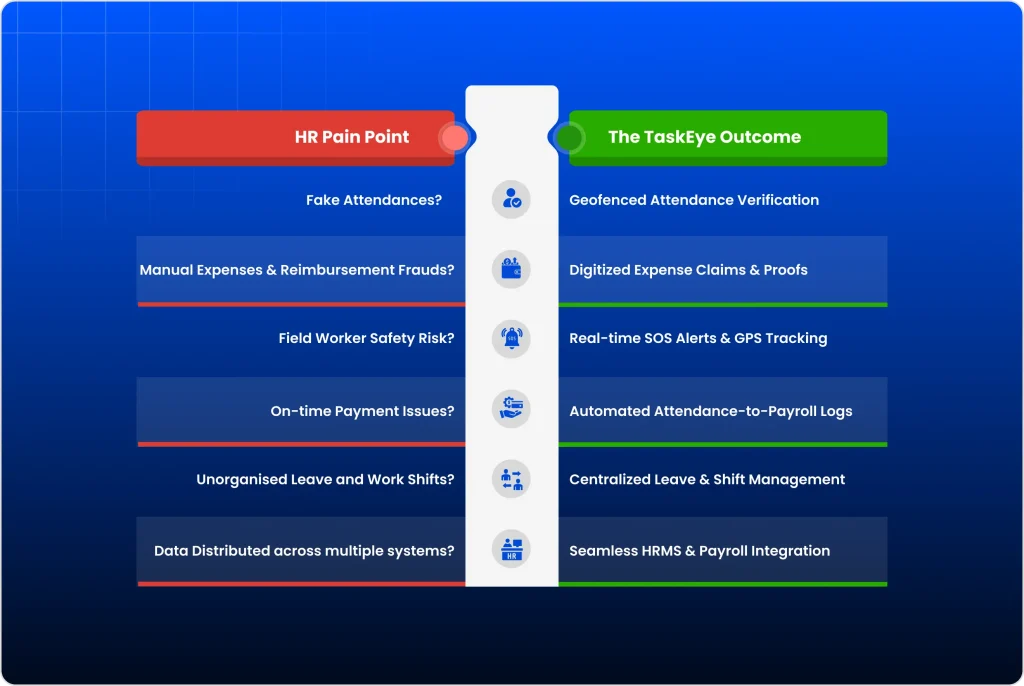
Start the conversation by addressing their specific pain points:
- How many hours do you spend resolving fake employee attendance submissions every month?
- What is your process to verify the accuracy of field-related expense claims?
- What steps are you taking to ensure that the field employee is safe at the assigned work location while working alone?
- How do you ensure that every team member is paid on time and in accordance with their pre-agreed payment terms?
- Are you able to accurately manage all field employee leave records without delays or errors?
- Do all the attendance, leaves, and expense records submitted by the field employees sync automatically in your existing payroll system?
These questions help them visualise and analyse the hidden challenges they face while managing field employees’ payroll and performance.
It also highlights the need for a reliable field employee management system to effectively manage field employee recruitment, payroll, and performance.
3. Mistakes to avoid while pitching a field employee tracking software to HR leaders
The biggest mistake many system integrators make when pitching field employee monitoring software to the HR leaders is focusing solely on employee tracking.
So, while presenting a new field team HR management system, don’t jump straight into technical features. Instead, you must prepare your pitch by highlighting the outcomes the software features deliver.
Furthermore, words like tracking and monitoring mislead HR leaders into thinking that the software is only for spying on employees. They find this sensitive and hesitate to listen to the product further. Instead, you must frame the software as a solution for better field employee management and on-field operation support.
If you over-emphasise GPS tracking and performance reports, they will not appeal to them, as they look for payroll accuracy and safety compliance. So even your strongest tools, like employee GPS tracking, will go unnoticed.
Lastly, the system integrators avoid clarifying the terms and conditions involved regarding the privacy, safety, and security of the field staff. This ignorance reduces credibility and the chances of adopting a new field service management system.
To avoid these mistakes, you must shift your focus from presenting technical features to pitching operational outcomes.
4. The HR pitch framework: Converting features into measurable HR benefits
To successfully pitch a field employee tracking software, you must shift your approach from explaining features to demonstrating their outcomes. They value accuracy, policy compliance, and employee trust, not technical details.
| Technical Features | Measurable HR Benefit |
|---|---|
| Geofencing Attendance Tracking and Leave Management | Accurate attendance logs and Guaranteed Payroll Integration |
| GPS Field Team Tracking | Attendance Accuracy & Verified On-field Presence |
| Expense Management | Faster reimbursements and financial transparency |
| SOS Alerts | Safety Compliance & On-time emergency assistance |
This framework helps you present each feature as a measurable business benefit that solves real HR challenges.
4.1. Guaranteed payroll integrity through verified attendance
The first shift is from attendance tracking to ensuring payroll accuracy. HR teams often struggle with manual errors and employee attendance disputes. You can solve this by pitching the need to upgrade their current HR attendance management system.
Start by explaining how a geofencing attendance system benefits them. The tool allows them to cross-check the log-in and log-out times with the field employees’ on-duty and off-duty timelines. This reduces the stress of fake attendance entries and creates an accurate record of audit-ready attendance logs.
4.2. Improved attendance accuracy with location-based verification
The next necessary shift is from tracking to verified on-field presence. Instead of presenting the software as a tracking system, pitch it as a location-verified attendance system to avoid privacy violations.
GPS tracking for field employees ensures that field staff are getting paid for completing the work while being present at their assigned locations. Additionally, you must also clarify with full transparency that the software only collects employees’ activity records during work hours.
This guarantees the HR leaders that the employee’s personal time is valued and, professionally, they are held accountable.
4.3. Enhanced financial transparency in expense management
The next shift is from expense control to accurate financial management. HR leaders often face delays in expense reimbursements due to manual claim processing. This leads to duplicate payment errors and incorrect claim processing.
To avoid this, offer a system that simplifies expense reimbursements for field teams through digital submission and faster approvals. Through this system, employees can click to submit expense receipts instantly and get paid fairly and on time.
4.4. Accurate field workforce availability analysis with leave management
HR leaders always lack clarity about field employee availability due to manual leave management and work-scheduling processes. This is your chance to pitch a systematic field employee leave management system for accurate visibility into the field team per day availability.
Such a system extends its scope beyond leave management. It improves employee shift planning, task allotment accuracy, and leave application policy compliance. Moreover, it also allows employees to apply for leave and communicate in advance with their managers about their unavailability.
4.5. Enhanced safety and security compliance with SOS alerts
Safety is a top priority concern for HR leaders dealing with employees working in the field. They worry about the team not having any safety and back-up assistance for employees working in high-risk areas. In such cases, you can pitch the importance of having a real-time SOS alert system.
On top of that, the system allows managers to provide emergency assistance to the field teams with live location and incident reporting. This ensures that the organisation is fulfilling its duty of care obligation by reducing employee safety risks.
4.6. Seamless integration with the existing HRMS system
Lastly, you can sum up your pitch by presenting TaskEye as an all-in-one solution for field employee tracking. Start by convincing them that our software is easy to integrate with their existing HRMS, with minimal training required.
The HRMS integration for field employee data also makes monitoring locations, attendance, expenses, daily field activities, and employee performance, more efficient. This reduces manual work and payment delays and improves organisations’ operational efficiency.
Now, let us explore the advanced strategies like white-labelling and integration benefits for system integrators.
5. Advanced strategies for pitching a field employee tracking software to HR teams
Here is an advanced step to further strengthen your pitch after discussing measurable business outcomes. Seal the deal with advanced white-labelling and integration strategies to build trust, establish credibility, and foster a long-term relationship.
To begin with, white-labelling allows you to present the field employee tracking system as an internal tool rather than an external system. It ensures the HR decision-makers that the solution will be integrated easily within their existing HRMS software, promoting acceptance across the organisation.
Consequently, a white-label field management for HR consultants serves as a trusted platform that aligns with the company’s policies. With white-labelling, you can present our software under your own brand identity and increase your business credibility. It allows them to customise the software with their brand name and logo to match their business requirements.
At the same time, integration with existing HRMS system is another advanced strategic point for your pitch. Highlighting how the field employee tracking software integrates seamlessly with their existing HRMS system is a huge deal closer. They will be happy to realise that the field team data, such as attendance, leaves, expenses, and payments, will get auto-synced. This will reduce their manual efforts, save time, and improve payroll accuracy.
By combining white-labelling strategies with seamless integration capabilities, you move from just selling a solution to becoming a trusted partner. Thus, you present a solution that is customised to their needs and is easy to adopt by their organization’s field team members.
This strategic way to end your pitch builds trust, impacts decision-making, and increases the adoption chances.

Summing Up!
Achieving success in today’s competitive market requires a smart, organised, and confident approach. You can stand out with a strategic pitch that balances the unique requirements of operations managers and HR heads while offering solutions to their challenges.
An organised field employee tracking software for HR connects on-field operations with the HR department. While the operations managers look for productivity and execution control, the HR decision makers value employee safety, policy compliance, and financial accuracy.
Thus, your pitch will be a success if you focus more on the outcomes than on bragging about the technical aspects of the software. Additionally, emphasising the ease of use and white-labelling customisation benefits will help you close deals and enhance your client portfolio.
From presenting TaskEye as just a tracking tool to a system that improves accuracy, compliance, and operational efficiency, you step ahead in the competitive market.